


I would argue that Man was conceived as an Idea before the physical creation – more like we translate the architectural blueprint of a building to physical structure.
 This article aims to enhance the understanding of programmers and scientists regarding the profound significance of their identity as creators. As stated in the Holy Bible, “God made us in His likeness,” suggesting that while we do not equate ourselves with the Creator, we possess capabilities reflective of our divine origin.
In the beginning, the earth was void. God envisioned creation and conceptualized a plan. The need for beings to inhabit the earth and exercise dominion led to the creation of humanity. However, God did not remain at the conceptual stage; He crafted a mental blueprint for the structure of humankind. Imagining the beauty of a being created in His own image, He sought a means to express Himself to the world.
With this model in mind, God designed what we now recognize as human beings. He understood that humans require breath, sustenance, thought, and creativity. Aware of these essential needs, He set to work, choosing not to delegate this task to angels. Instead, He invested His effort into realizing the model He had envisioned. God meticulously formed the mold, combining features with exceptional specifications. Finally, He breathed life into humanity, and thus “Adam” became a living being, embodying the life, form, and functionality of God.
The insights above may appear theoretical to some, but they clearly illustrate the parallels between God’s creation and the work of programmers and scientists today. Just as God modeled structures, objects, and abstract forms of energy during creation, programmers also create complex systems using computers.
At the core of any good software program is a main class. This main class serves as the fundamental representation of the entire system or software. Essentially, the name of the main class reflects the software itself; when mentioned, it should evoke recognition, much like responding to one’s name. The main class abstracts the primary object and encompasses various compositions, properties, and associations.

It is crucial to note that every software program must have at least one class, which becomes the base class. This base class provides a necessary identity for the formation or creation of objects.
The CLASS as a standalone can be defined as an abstract representation of an Object.
 Before a programmer begins their work, they must carefully plan, understanding the procedures and steps involved in the System Development Life Cycle (SDLC). The project starts with identifying a need, which leads to a solution and, ultimately, the conceptualization of an idea. This idea is the foundation upon which the final product will be built. The programmer must start somewhere, thinking about a formula on how to build around the idea.
For instance, when developing a soccer game, the programmer would code the main class with the name of the game, such as “PRO SOCCER.” Additional classes could represent the players on the field, like Messi and Ronaldo. Configuring each player involves a detailed process, as each has unique playing styles and characteristics. The programmer must input the specific properties and compositions of each player within their respective modules. Messi for example does not have the same style of play as Ronaldo and in turn the Programmer decisively inputs all the compositions and properties of each player on their particular Module/Object.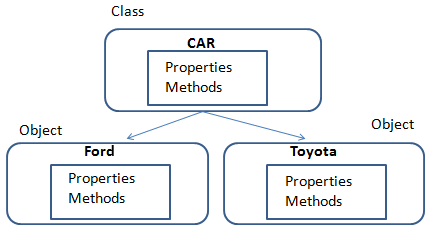
This brings me to the discussion on Attributes of the Object to be created.
An attribute defines the characteristics that make a module unique. While different modules can share the same attribute—like Ronaldo and Bale both having a running speed of 90 m/s—attributes are vital for giving meaning and purpose to an object. Attributes determine whether a player is tall or short, fair or dark.
Attributes also give rise to methods. Methods, or functions, represent the actions that can be performed on an object based on its composition and structure.
For example, consider the action “SLAP”: if Person A slaps Person B, B experiences an impulse and reacts by shouting, “OUCH.” In this scenario, Person A triggers a method in Person B, resulting in a specific response. Similarly, in programming, when a method is invoked, it produces an outcome based on the input given. That Impulse can be termed a function or a method. Whenever a method is called on a program, it produces an effective response considering the input from the operating party.
We encounter this in our everyday experiences with video games. When a player taps the “Block” command, the character shoots the ball in a designated direction. The underlying code that executes this action is what we refer to as a method or function.
As humans, we were not only created to exist but to be creative, much like God. It is essential to discover our potential and take decisive action. Programmers have a significant role to play in this creative endeavor!!
